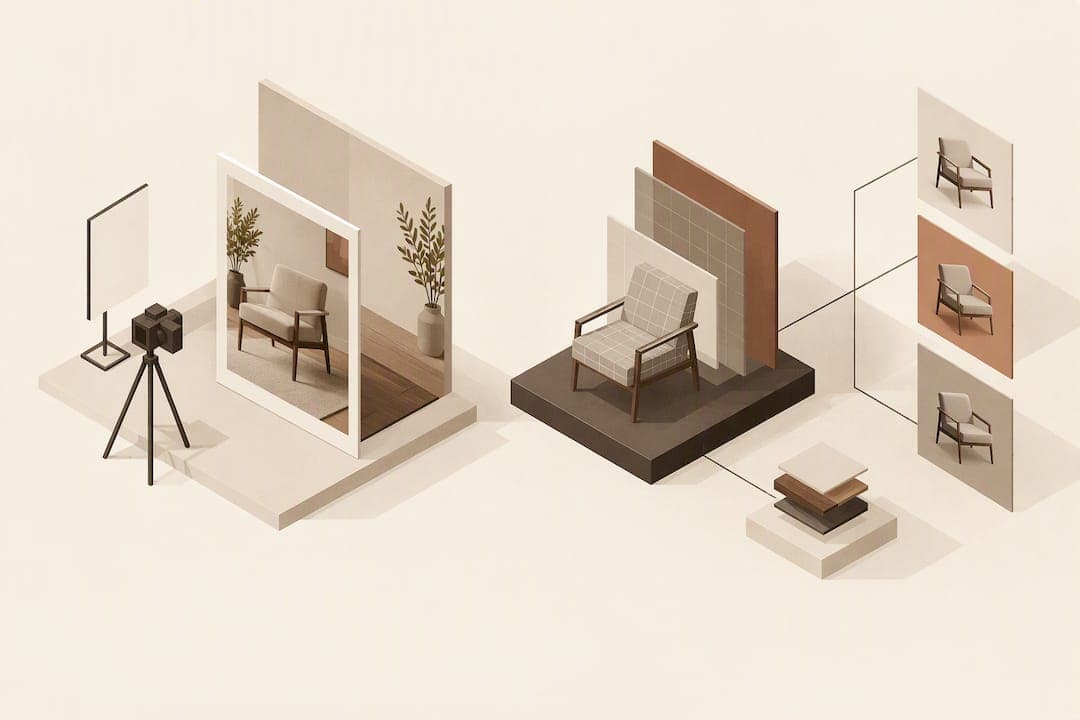
For a single emotional hero image or a quick lifestyle campaign, photography wins. For variant-heavy catalogues, technical visuals or multi-channel exports like AR and 360 spins, 3D modelling pays off faster. Most teams end up running both, and knowing where the break-even sits is the real skill.
TL;DR:
- Photography remains most effective for capturing textures and human presence in emotional lifestyle images, but is less scalable for large variant catalogues.
- 3D modelling is cost-effective at scale due to low marginal costs per variant after initial creation, making it ideal for technical visualisation and configurators.
- Producing a 3D asset typically costs between $150 and $5,000 in 2026, with the initial model build being the most expensive part and subsequent variants costing much less.
- Mixing methods by using photography for hero shots, 3D for catalogues, and AI for ideation offers a practical workflow tailored to project needs.
- For fast room previews, photorealistic compositing from existing product images can deliver quick results without requiring a full 3D pipeline.
Table of Contents
- Photography, compositing, 3D modelling and rendering: the basic terms
- Where photography still wins for product and architectural work
- Where 3D modelling earns its cost back
- Comparing the two across cost, realism, speed and channels
- What 3D and photography actually cost in 2026
- How teams actually mix photography, 3D and AI in production
- A decision checklist for your next brief
- Why photo compositing is the pragmatic choice for many furniture retailers
- A faster route to room previews for furniture retailers
- FAQ
- Sources
Photography, compositing, 3D modelling and rendering: the basic terms
Photography captures a real object with a camera. Photo montage, or compositing, blends photographed elements, often a product shot layered onto a background or room scene, without building any geometry. 3D modelling builds a digital object from scratch: geometry first, then texturing (applying surface materials) and rendering (calculating light and shadow to produce a final image).
Photogrammetry sits between the two: it reconstructs a 3D shape from multiple photographs, useful for ideation but rarely accurate enough for production without cleanup. AI-assisted generation increasingly fills the same early-stage role, quick visual exploration rather than dimensionally reliable output.
Deliverables typically export as JPEG or PNG for web and print, OBJ or GLB for 3D assets moving between software, and USDZ for AR viewing on mobile devices. Knowing which format a brief actually needs saves a lot of wasted production time.
Where photography still wins for product and architectural work
Photography captures texture, light and human presence in ways that remain hard to fake. A linen sofa's weave, the grain in reclaimed oak, a person's hand resting on a worktop: these details carry emotional weight that photography delivers naturally, which is why lifestyle and campaign hero images are still shot on cameras rather than rendered.

When the item already exists and only a handful of variants need capturing, photography is usually quicker and cheaper upfront. A studio day can produce dozens of final images without any modelling lead time.
The drawbacks show up at scale. Sample handling, storage, styling and reshoots add up fast once a catalogue runs into hundreds of SKUs, and every colourway or configuration change means another physical sample and another shoot.
- Strongest for one-off emotional or lifestyle imagery where mood matters more than precision.
- Fast and comparatively cheap when variant counts are low and the product already exists.
- Weak for scaling across many SKUs, since every variant needs its own physical sample and shoot.
- Vulnerable to logistics: damaged samples, studio bookings, weather for outdoor architectural shoots.
Pro Tip: Reserve photography budget for the handful of images that need to sell a feeling, not every SKU in the catalogue.
Where 3D modelling earns its cost back
Once a 3D model exists, producing a new colourway, angle or configuration costs a fraction of the original build. That reusability is what makes 3D the practical choice for large variant catalogues, where the same chair might need to appear in twelve fabrics and four leg finishes.
3D also gives precise dimensional and material control, which matters for architectural visualisation and any technical visual where accuracy, not atmosphere, is the point. A kitchen configurator or a furniture AR export needs geometry that matches real-world measurements, not an approximation.
The trade-off is upfront labour. Clean-topology modelling, texturing and material setup take real time and skill, and photorealism depends heavily on both. A rushed 3D render can look worse than a decent photograph, so the labour investment has to be proportionate to how many times the asset will be reused.
- Low marginal cost per additional variant once the base model is built.
- Precise control over dimensions and materials, suited to configurators and arch-viz.
- High upfront modelling cost that only pays off with reuse.
- Best suited to catalogue grids, AR exports and architectural visualisation rather than single hero shots.
Pro Tip: Ask any 3D vendor how many variants it takes before the per-image cost drops below a comparable photo shoot. That number is your break-even.
Comparing the two across cost, realism, speed and channels
The decision rarely comes down to taste. It comes down to how a project behaves across five practical dimensions.
Cost shape is the biggest differentiator. Photography has a relatively flat cost per image; 3D has a high initial cost that falls sharply per additional variant. A catalogue with two or three colourways might favour photography; one with a dozen almost always favours 3D.
Realism works differently for each method. Photography wins when imperfection and human context matter, a lived-in room, a hand on a surface, natural light falling unevenly. 3D wins when precision matters more than atmosphere, exact proportions, consistent lighting across a whole grid, or a material that needs to match a specification sheet exactly. A comparative study published in Horizons in Architecture and Urban Studies found that AI-assisted renders can match traditional physics-based rendering for structured, geometric interior styles, while physics-based 3D retains the edge for organic, texture-rich styles.
Speed and turnaround depend on where the bottleneck sits. Photography's bottleneck is studio logistics: booking, sample prep, reshoots. 3D's bottleneck is the model build itself; once that's done, turnaround for new angles or variants is fast.
- Cost: photography is flat per image; 3D is high upfront, low marginal.
- Realism: photography suits emotional or textured context; 3D suits precision and consistency.
- Speed: photography bottlenecks on logistics; 3D bottlenecks on the initial build.
- Channels: 3D exports natively to AR, configurators and 360 spins; photography does not.
What 3D and photography actually cost in 2026
Pricing varies by studio and complexity, but published 2026 guides give a useful baseline. A 2026 pricing guide for 3D product rendering lists the following typical ranges.
| Deliverable | Typical 2026 price range |
|---|---|
| Static CGI product image | $150 to $500 |
| Photorealistic hero image | typically costs more, within a mid-range bracket |
| 360° spin | $500 to $1,500 |
| AR-ready 3D model | $500 to $5,000 |
| Interactive configurator | usually carries a significant investment, with prices varying greatly |
The same pricing guide notes that modelling labour, not render time, typically dominates a 3D quote. Once clean-topology geometry and materials exist, additional angles or colourways cost far less than the first image.
That's the logic behind the commonly cited break-even point: 3D tends to pay off by the second or third variant, because the expensive part, building the model, happens once, and every subsequent variant is marginal cost from there. A brief with a single SKU in one finish rarely justifies a 3D build; a brief with eight finishes almost always does.
Studio arch-viz work follows a similar shape, often running £1,500 to £3,000 or more per image in professional practice, with community-reported freelance rates varying widely enough that they're best treated as a sanity check rather than a price list.
How teams actually mix photography, 3D and AI in production
In practice, few brands pick one method and stick to it. A common pattern is lifestyle photography for hero and campaign images, a 3D catalogue for the bulk of SKU variants, and a photo-compositing layer for customer-facing tools like room previews. Each method does the job it's best suited to rather than trying to cover everything.

AI-assisted generation tends to sit at the ideation stage: quick mood boards, early layout exploration, style testing before anything gets built properly. It's efficient for that, but outputs still need validating against measured dimensions before they're trusted for anything production-critical. Photogrammetry has a similar role, converting photos into rough 3D shapes that usually need cleanup before they're reliable.
A few operational habits save headaches later. Clarify who owns the final model and textures before work starts, agree how many revision rounds are included, confirm file formats up front (GLB or USDZ if AR is on the roadmap), and insist on source files rather than flattened renders if you expect to reuse the asset later.
A decision checklist for your next brief
Before commissioning anything, work through a short set of questions.
- How many variants does this SKU or scene need, now and over its lifecycle?
- What fidelity does the brief actually need, emotional atmosphere or dimensional precision?
- Is the budget one-off or ongoing, a single campaign or a catalogue that will grow?
- What's the deadline, and does a model build fit inside it?
- Which channels need the asset: web grid, print, AR, configurator, social?
- Who owns the source files once the project ends?
When briefing a vendor, ask directly about model ownership, how many revision rounds are included, which file formats they'll deliver, and whether the asset is AR-export ready if that's on the roadmap. A quote that's vague on any of these points, especially ownership, is worth questioning before signing off.
Three quick examples: a single hero shot for a seasonal campaign almost always points to photography. A twelve-variant sofa range pointed at an e-commerce grid and a future AR feature points to 3D. A furniture retailer wanting customers to preview products in their own room, without committing to a 3D pipeline, is often better served by a compositing tool built for that specific job.
Pro Tip: If you can't answer the variant-count question yet, default to photography for the first round and revisit 3D once the catalogue's real size becomes clear.
Why photo compositing is the pragmatic choice for many furniture retailers
A full 3D pipeline makes sense when a catalogue is large enough and stable enough to justify the modelling investment. Plenty of furniture retailers aren't there yet, or don't want to be. For them, a photo-compositing widget that works directly from the JPEGs they already have, no 3D build, no app download for the shopper, offers a faster route to the same outcome: a shopper seeing how a piece looks in their own room.
That lower setup overhead tends to matter more than theoretical image quality for a retailer trying to reduce returns and move faster. It's a trade worth weighing against a full catalogue build, not a replacement for 3D in every case, but a legitimate shortcut for a specific, common job.
— Michael
A faster route to room previews for furniture retailers
We built our tool around the same insight that runs through this whole comparison: not every retailer needs a full 3D pipeline to solve the "will this fit my room" problem. Our widget works from the product photos you already have. A shopper uploads a photo of their own room, and within a short time we composite your product into that photo without asking them to install anything.
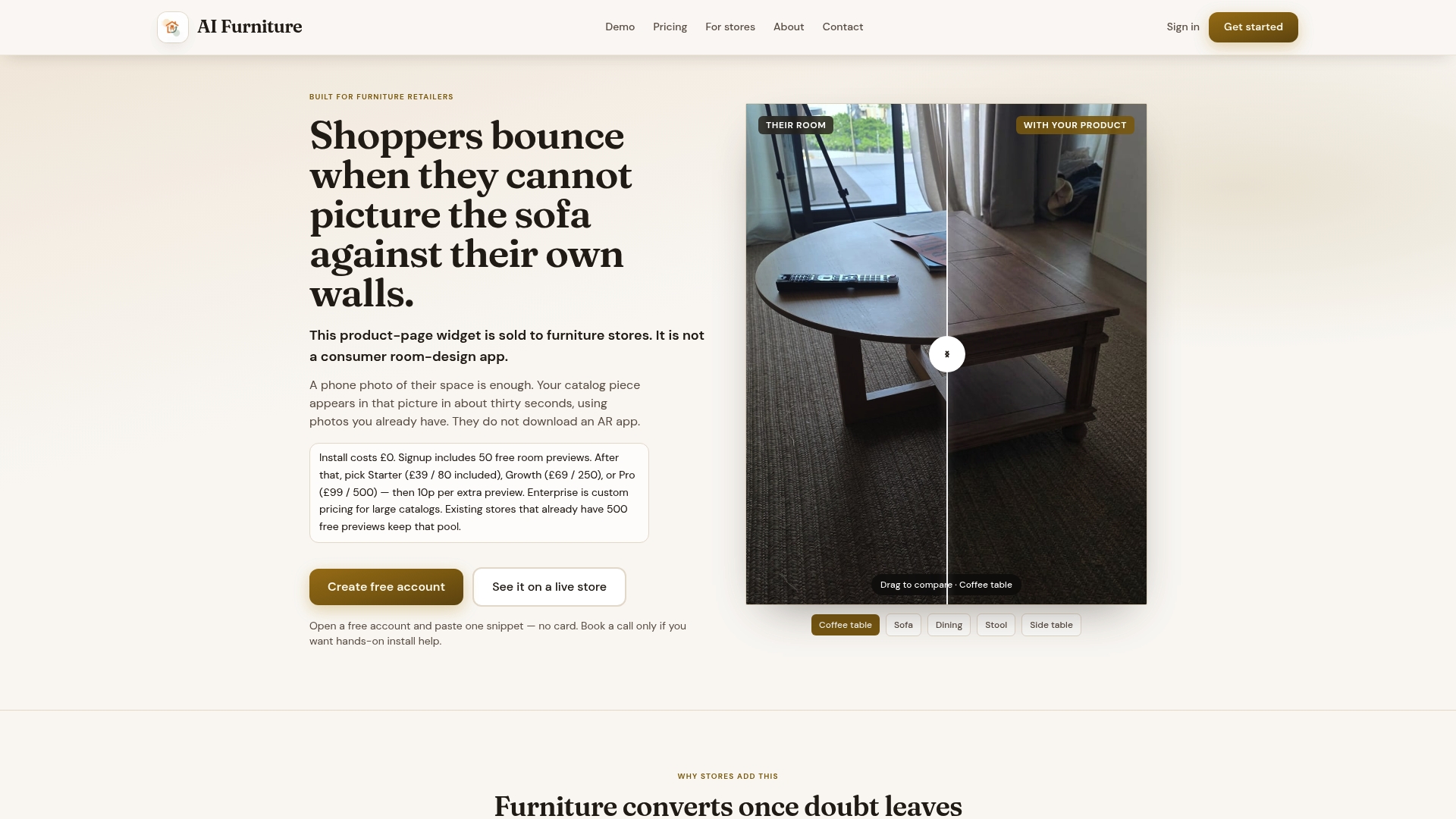
- No 3D models or AR apps required, just the JPEGs already on your product pages.
- Billing based on actual usage rather than a flat setup fee or long build time.
- Works across common e-commerce platforms and custom storefronts.
If you're weighing this against a full 3D catalogue build, our comparison of compositing, 3D and visualiser apps lays out where each approach fits. Retailers who scan and digitise physical samples, as described in One Day Doors & Closets' trade program, face a similar build-versus-buy decision; compositing tends to win when speed to launch matters more than a bespoke 3D asset library. Start with 500 free previews on our pricing page and see how it performs on your own catalogue before committing to anything.
FAQ
How much does a 3D photo cost?
Published 2026 pricing guides put a static CGI product image between $150 and $500, a photorealistic hero image between $300 and $1,000, and an AR-ready 3D model between $500 and $5,000. Costs rise with complexity and the number of variants required.
What are two types of 3D modelling?
Common approaches include polygon modelling, which builds geometry from vertices, edges and faces, and photogrammetry, which reconstructs a rough 3D shape from multiple photographs. The two differ mainly in how much manual cleanup and dimensional accuracy the result needs before it's production-ready.
Is a photo 2D or 3D?
A standard photograph is a two-dimensional image, a flat grid of pixels capturing light from one camera position at one moment. It can be used within 3D workflows, for texturing a model or compositing onto a background, but it does not itself contain 3D geometry.
Can you turn a photo into a 3D model?
Photogrammetry and some AI-assisted tools can generate a rough 3D shape from one or more photographs, which is useful for early ideation. The result usually needs cleanup and should be checked against measured dimensions before it's trusted for anything production-critical.
Sources
- Pixels, prompts, and precision: a comparative analysis of AI-assisted and traditional architectural visualization across diverse interior design styles | Horizons in Architecture and Urban Studies
- 3D product rendering cost in 2026: Real prices, per-image