
A clear, tightly scoped return policy paired with product-page prevention beats blanket free returns every time margin is on the line. The single best first move is measurement: tag every return by SKU and add assembled and packaged dimensions to your top sellers. Benchmarks show furniture returns sit in identifiable tiers, and tools such as AI Furniture Solutions now let retailers attack the fit-and-style problem directly at the source.
TL;DR:
- Implement a clear return scope and condition standards, with distinct timelines for change-of-mind and defect-based returns, to protect margin and reduce unnecessary returns.
- Use reason codes on returns to identify top product issues such as size, color, damage, or missing parts, allowing targeted improvements on high-return SKUs.
- Enhance product pages with detailed dimensions, accurate visuals, and tiered delivery options to prevent returns caused by fit, appearance, or delivery damage.
- Employ remote assessment tools like guided photo and video intake to avoid 30 to 50% of physical returns, especially on damaged furniture claims.
- Measure return rate, costs, resolution time, and customer satisfaction regularly; run pilot interventions on top SKUs to optimize policies without broad overhauls.
Table of Contents
- Why does a furniture return policy matter more than in other categories?
- What causes most furniture returns and how do you find them?
- How do you design a furniture return policy that protects margin?
- Which product-page fixes cut returns before they happen?
- How should you handle returns you can't prevent?
- How do you measure and test what actually works?
- What legal rules govern furniture return policies?
- How do you communicate return policies without inviting disputes?
- How should you handle returns on large or customised furniture?
- What return window actually balances conversion and margin?
- Do generous return policies actually build customer lifetime value?
- Author perspective and practical trade-offs
- A faster way to close the fit-and-style gap
- Sources
- FAQ
Why does a furniture return policy matter more than in other categories?
A returned sofa is not like a returned t-shirt. Reverse freight runs both ways, someone has to inspect it, warehouse staff rehandle it, and the item usually gets marked down as open-box stock before it sells again. Illustrative figures on a $1,500 sofa show two freight legs plus inspection and markdown can consume the entire gross margin on the original sale.
That is why furniture ecommerce works on different benchmarks than apparel. A return rate below 15% puts you ahead of the category; 15–20% is mainstream; 20–23% counts as high but not alarming; anything above 25% signals a specific problem worth root-cause work rather than a blanket policy fix.
The number that should worry you: a category-average furniture return can erase most of its own margin once you count both freight legs and the open-box discount. That single fact should drive how generous your policy language can afford to be, because return policy wording at checkout shapes conversion too. Shoppers read the fine print before they buy a $2,000 sectional, and a vague or overly restrictive policy pushes them straight to a competitor's cart.
What causes most furniture returns and how do you find them?
Most returns trace back to one of four owners: the product page (wrong expectations on size or colour), logistics (damage or missed delivery windows), manufacturing (structural faults), or assembly (missing parts, confusing instructions). Treating all returns as one undifferentiated cost hides which owner needs fixing.
Adding reason codes to your returns intake process changes that. Retailers who run this exercise often find:
- "Didn't fit the space" dominates sofas, sectionals and dining tables.
- "Colour or fabric different than expected" clusters around upholstered pieces without swatch programmes.
- "Arrived damaged" concentrates on a handful of SKUs with weak packaging, not the whole catalogue.
- "Missing parts" points squarely at assembly instructions or supplier quality control.
Once reason codes exist, rank SKUs by returns multiplied by freight cost. A 90 minute audit on your top 20 SKUs by revenue typically surfaces the two or three products responsible for most of your reverse-logistics losses, and those are the ones worth fixing first.
How do you design a furniture return policy that protects margin?
A policy built from vague generosity or blanket restriction both fail. Sector analysis suggests a precise, plain-language policy paired with prevention levers reduces returns without hurting conversion, which is the balance every retailer is actually chasing.
Structure the policy around four components:
- Scope. State exactly what qualifies for return: standard-catalogue items, yes; final-sale clearance, no; custom orders, only under specific fault conditions.
- Condition standards. Define "resaleable condition" in plain terms: original packaging where feasible, no assembly beyond test-fit, no signs of use.
- Timeline splits. Separate the returns window (typically 14 to 30 days for change-of-mind) from the warranty window (often one to five years for structural defects), so shoppers understand these are different promises.
- Explicit exceptions. Call out custom fabric, made-to-order dimensions and clearance stock by name, not by implication.
On freight, set tiers by item value and size: small parcel items ship back on the customer's dime past a short window, while white-glove and large-item pickups need a scheduled reverse-collection fee. When the reverse cost would exceed the item's residual value, a keep-it credit (partial refund, no pickup) is usually the more profitable move for both sides.
Pro Tip: *Write your restocking fee clause with a worked example, not just a percentage.
Which product-page fixes cut returns before they happen?
Prevention beats refund processing every time, and it starts with content most retailers already have the raw material for.
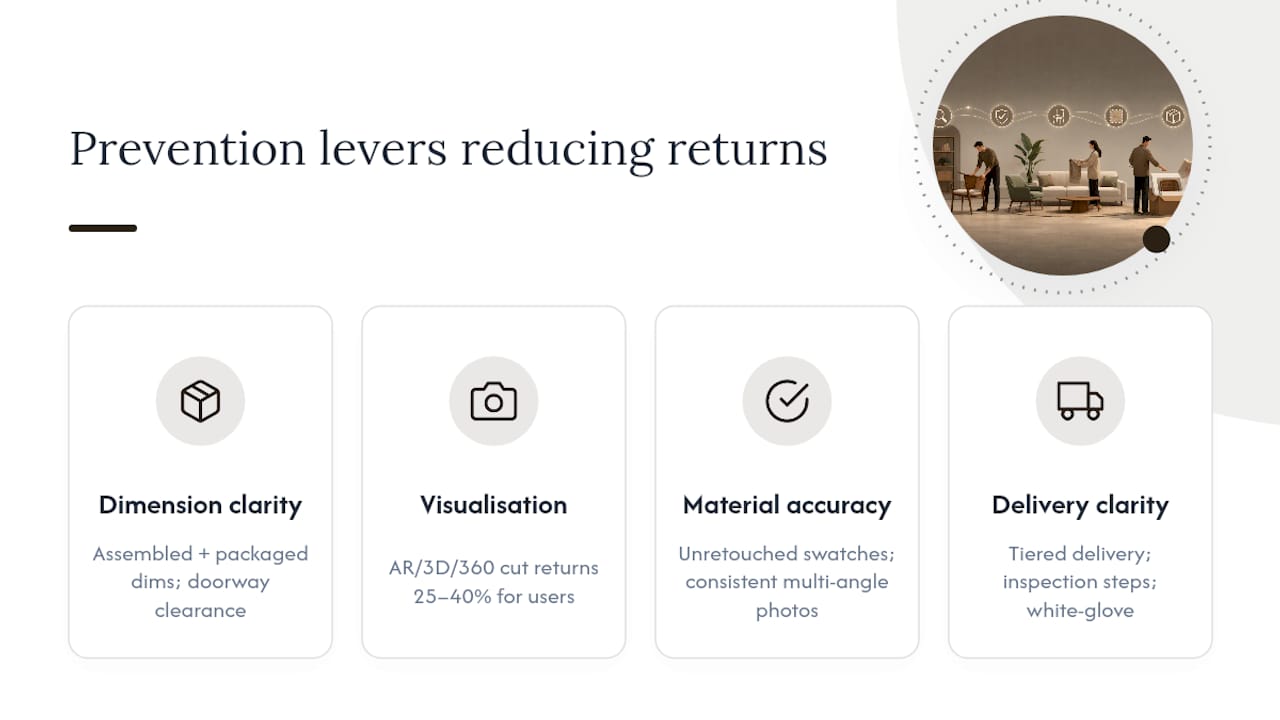
Dimension clarity is the cheapest fix available. List assembled dimensions alongside packaged dimensions, note doorway and stairwell clearance, and state carton count plus the longest single panel length. This single content layer prevents failed and refused deliveries before a courier even reaches the door, and it costs nothing to implement on SKUs you already sell.
Visualisation is the lever with the clearest data behind it. AR, 3D and 360-degree tools reduce returns by roughly 25 to 40% among shoppers who actually use them. That "among users who actually use them" clause matters more than the headline number: a visualisation tool sitting unused on a product page delivers nothing. Adoption, not availability, is what you should be measuring and reporting internally.
Material accuracy closes the gap between screen and sofa. Unretouched swatch photography, multi-angle shots under consistent lighting, and a physical sample-swatch programme for upholstered pieces all reduce the "colour looked different in person" complaint that dogs fabric-heavy categories.
Delivery clarity finishes the job. Offer tiered delivery options at checkout, from kerbside to full white-glove room placement, and give clear inspection-on-delivery instructions so damage gets flagged and resolved at the door rather than three weeks later. White-glove delivery in particular tends to reduce damage and refused-delivery returns, often for less than the cost of one reversed freight leg.
Practical work on cutting return rates through visualisation and reducing cart abandonment tied to fit uncertainty both point the same direction: the earlier you resolve doubt, the fewer returns you process later.
How should you handle returns you can't prevent?
Some returns are unavoidable, and the goal shifts from prevention to cost containment. A guided photo-and-video intake process, where the customer submits images before anything ships back, should be your default first step.
Remote assessment done well avoids 30 to 50% of physical returns that would otherwise have triggered a reverse pickup, saving roughly $150 to $300 per case in avoided freight and handling. That is not a marginal saving on a bulky-goods P&L; it is often the difference between a profitable order and a loss-making one.
Build simple decision rules on top of that intake:
- If the fault is cosmetic and low-value, offer a partial refund or store credit rather than scheduling pickup.
- If the item still has resale value and the fault is structural, authorise reverse pickup and route it into a disposition channel.
- If packaging is intact and the issue is a customer change of mind, a keep-it credit often costs less than the round-trip freight.
For items that do come back, decide the disposition path before they arrive: an outlet or resale channel for lightly used stock, a refurbishment queue for repairable pieces, and B2B liquidation for anything that won't move at retail. Retailers processing more than a handful of furniture returns a month generally benefit from formalising this as a standing pipeline rather than deciding case by case.
How do you measure and test what actually works?
Track five numbers, not fifty: return rate by SKU, fully loaded cost per return, remote-resolution rate, time-to-resolution, and post-claim customer satisfaction. Fully loaded cost per return means both freight legs, rehandling labour and any markdown taken on the returned unit, not just the refund issued.
Run interventions as pilots, not company-wide overhauls:
- Pick your top 20 SKUs by revenue or return volume.
- Apply exactly one prevention lever, such as adding assembled dimensions or turning on a room-preview widget.
- Measure return rate and cost per return over 90 days against the prior period.
- Set a decision threshold in advance, for example a 20% relative drop in returns to justify wider rollout.
Fold the result into pricing. The effective landed cost of a SKU is its wholesale cost plus its fully loaded return cost divided by units sold. Two SKUs with identical wholesale cost can carry very different margins once returns are priced in, and that number should sit next to gross margin on every merchandising review.
What legal rules govern furniture return policies?
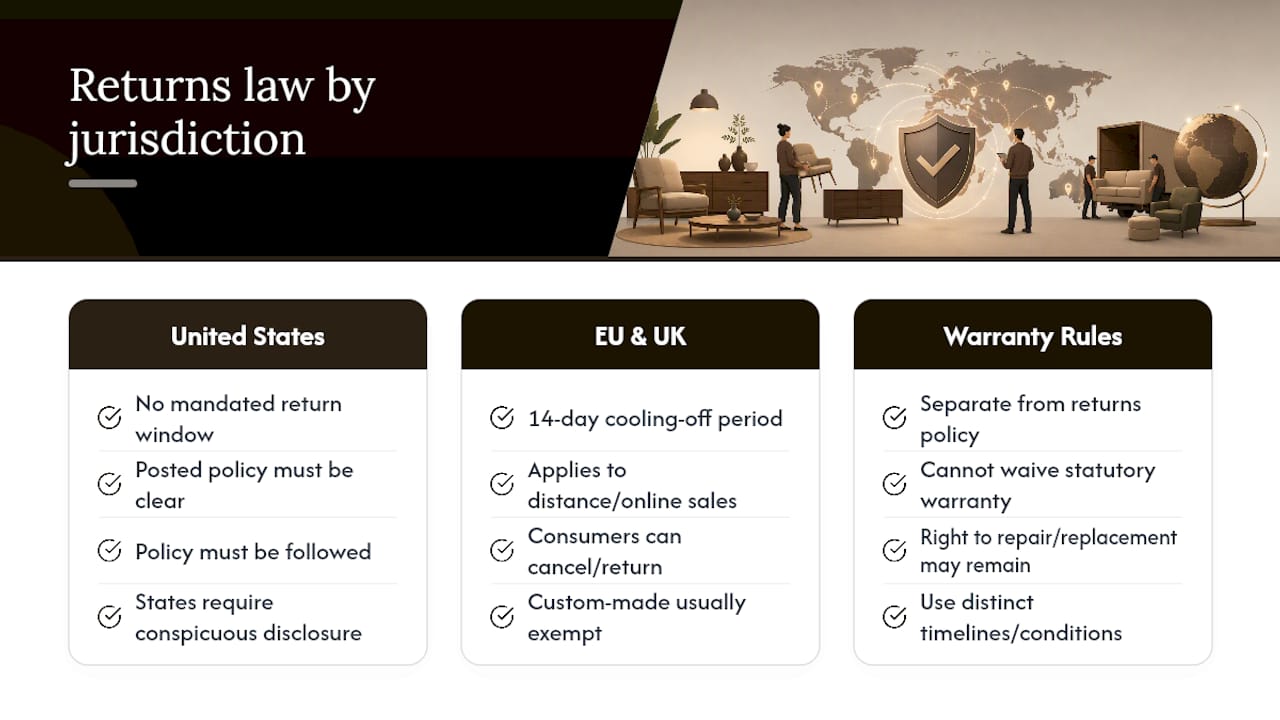
Consumer protection law varies significantly by country, and it typically sets a floor under your policy rather than a ceiling. In the United States, the Federal Trade Commission does not mandate a specific returns window for general retail, but it does require that whatever policy you post is disclosed clearly and followed consistently, since deceptive or unposted policies can trigger FTC action. Several states go further and require conspicuous in-store or on-site disclosure of return terms, particularly around restocking fees.
Within the EU and UK, distance-selling rules give consumers a statutory cooling-off period, generally 14 days from delivery, for goods bought online, during which they can cancel and return an item independent of what your posted policy claims. Custom-made or made-to-order furniture is normally exempt from this cooling-off right, but that exemption typically applies only if the customisation is genuine and was clearly flagged as non-cancellable at the point of sale. Retailers who bury this exemption in fine print, rather than stating it plainly during checkout, tend to lose disputes even when the underlying law is on their side.
Warranty obligations sit separately from returns policy and usually cannot be waived below a jurisdiction's statutory minimum, which means a "no returns after 30 days" clause cannot legally override a consumer's right to a repair or replacement for a genuine structural defect discovered months later. The practical fix is to keep returns and warranty as two clearly separated sections in your policy document, each with its own timeline and its own conditions, so customers and your own support team aren't left guessing which rule applies to which complaint.
How do you communicate return policies without inviting disputes?
Most disputes come from a gap between what a customer assumed and what the policy actually says, and that gap is almost always a communication failure, not a policy failure. Plain language beats legal-sounding boilerplate every time a support ticket gets opened.
Three habits do most of the work. First, surface the policy at the point of decision, not just buried in a footer link. A one-line summary next to the "add to basket" button ("30-day returns, free exchanges, custom orders final") sets expectations before money changes hands. Second, confirm the policy again in the order confirmation email, ideally with the specific return window and condition requirements spelled out for that exact SKU rather than a generic boilerplate paragraph. Third, train support staff to quote the same plain-language version customers saw at checkout, not an internal legal draft with different wording, because inconsistent phrasing between what a shopper read and what an agent tells them is one of the fastest ways to escalate a routine query into a chargeback.
Restocking fees deserve particular care. A bare percentage buried in a clause reads as a penalty; a worked example next to it reads as a fact. Retailers who show the pound amount alongside the percentage report fewer disputes, because customers can do the maths themselves before they commit to a return rather than feeling ambushed by a deduction on their refund.
Finally, treat your returns page as a trust asset, not a legal shield. A policy written to be understood in under a minute, with condition standards and timelines stated as facts rather than warnings, tends to reduce both dispute volume and the emotional heat of the disputes that do happen.
How should you handle returns on large or customised furniture?
Large and customised pieces need their own rulebook, because the assumptions that work for a £200 side table collapse on a £3,000 made-to-order sectional. Custom orders, by definition, have no resale value to a second buyer in the exact configuration ordered, so most retailers exclude them from standard returns and instead offer a fault-only remedy: repair, partial credit, or replacement parts, not a full reverse pickup.
Restocking considerations differ sharply between catalogue stock and bespoke builds. A standard-line sofa returned in resaleable condition can usually go back into inventory at a modest markdown. A custom-fabric sectional cannot go back into general inventory at all; it either goes to an outlet channel at a steep discount, gets refurbished and resold as an open-box unit, or, if the fault lies with the customer's own measurement error rather than a manufacturing defect, gets excluded from return entirely under the policy's custom-order clause.
Refurbishment decisions hinge on the fault type. Structural faults on large pieces (a broken frame, a failed mechanism) usually justify a repair-and-resell path, since the frame itself often retains most of its value. Cosmetic faults (a scuffed panel, a stained cushion) are frequently cheaper to fix on-site with a replacement part shipped to the customer than to process as a full return. The decision rule worth adopting: if the fix costs less than the round-trip freight on a large item, send the part or the technician, not the pickup truck.
What return window actually balances conversion and margin?
Longer return windows tend to lift conversion at the point of purchase, because they lower the perceived risk of a big-ticket decision. They also raise the average cost per return, because more time passes before a fault surfaces, more items get lightly damaged in home use before being sent back, and more returns arrive outside any useful resale window.
The fix is not to guess at a single ideal number. It is to split the timeline by product risk. Small, low-cost accessories can carry a longer, more generous window because the reverse cost per unit is low. Large upholstered furniture and anything requiring assembly should carry a shorter change-of-mind window (commonly 14 to 30 days), backed by a separate, much longer structural warranty that only covers genuine defects rather than buyer's remorse.
Retailers who blend these two timelines into one number tend to get the worst of both outcomes: either a window too short to build purchase confidence on expensive items, or a window so long that returned stock has depreciated past any resale value by the time it comes back. Splitting "change of mind" from "manufacturing fault" and pricing each timeline separately is the single highest-leverage adjustment most furniture retailers haven't made yet.
Do generous return policies actually build customer lifetime value?
A returns policy shapes brand reputation well beyond the transaction it governs, because furniture purchases sit at the high-trust, high-consideration end of ecommerce. A shopper who reads a confusing or punitive policy before buying a £1,800 dining set often abandons the cart entirely rather than risk a bad outcome, and that lost sale never shows up in your returns data at all.
The customers who do experience a return, and have it resolved cleanly and predictably, frequently become more loyal than customers who never needed the policy at all. A fair, well-communicated resolution on a damaged delivery converts a potential one-star review into a repeat buyer, because it demonstrates the retailer stands behind its product when things go wrong.
The reverse is equally true and more damaging. A restrictive policy discovered only after a problem occurs (a hidden restocking fee, an unstated exclusion for custom fabric) tends to generate public reviews and social complaints disproportionate to the transaction value, precisely because furniture purchases are infrequent and emotionally weighted compared with routine ecommerce. One bad furniture-return experience, aired publicly, can suppress conversion on that SKU for months.
The practical implication for lifetime value: a moderately generous, clearly stated policy that pairs with prevention (so fewer returns happen in the first place) outperforms both a maximally lenient policy and a maximally strict one. Lenient-but-vague policies erode margin through disputes and abuse; strict-but-unclear policies erode trust and suppress the next purchase. Clarity, not generosity alone, is what protects both.
Author perspective and practical trade-offs
Most furniture retailers reach for a blanket policy change when returns spike. That is usually the wrong instinct. A prevention pilot on your top 20 SKUs will tell you more in 90 days than a company-wide policy rewrite tells you in a year, because it isolates cause from effect instead of guessing at both.
The real tension isn't generosity versus strictness. It's conversion lift from a lenient policy versus the freight risk that lenient policy creates on big-ticket items. Both are real. Model returns into your margin planning line by line, SKU by SKU, and the trade-off stops being a guess.
— Michael
A faster way to close the fit-and-style gap
Most of the prevention levers covered above (dimension clarity, swatches, delivery tiers) require content work you can start today. Visualisation is the one that usually needs a tool, and this is where A visualisation widget lets a shopper upload a photo of their own room and see furniture composited into it within roughly 30 seconds, with no app download and no 3D modelling required on the retailer's end.
That maps straight onto the adoption problem this article keeps returning to: visualisation only reduces returns when shoppers actually use it, and a friction-free, no-download tool removes the biggest barrier to that adoption. It works from the product photography you already have, integrates with Shopify alongside Magento, BigCommerce, WooCommerce and custom storefronts, and comes with a dashboard to track usage against your own return-rate benchmarks.
A free trial offering provides an initial number of free room previews before billing begins, allowing retailers to run a pilot on their highest-return SKUs and measure the impact. If you want to see how the approach stacks up against photography, 3D modelling and other Shopify visualiser apps, the comparison page breaks down the trade-offs directly.
Sources
The figures and thresholds in this guide draw on furniture-specific returns research, including cost breakdowns from SodaWebMedia, remote-assessment savings data from ClaimLane, category benchmarks from Eightx, and content-layer guidance from Ecommerce Fastlane. For a practical implementation checklist, see the return-reduction guide.
- Furniture Returns: Rates, Costs, and Fixes (2026)
- Furniture Returns Management
- Furniture and Home Return Rate Benchmarks (2025) | Eightx
FAQ
What is a furniture return policy, exactly?
It's the set of rules a retailer publishes covering what furniture can be returned, within what timeline, in what condition, and who pays freight, separate from any warranty covering manufacturing defects.
What is a normal furniture return time frame?
Most retailers set a 14 to 30 day change-of-mind window for standard catalogue items, backed by a separate, longer warranty period of one to five years that covers structural defects only.
How do you handle returning damaged furniture?
Start with a guided photo or video intake before authorising any pickup; this remote assessment step alone avoids 30 to 50% of physical returns that would otherwise need a full reverse collection.
Does a furniture exchange policy reduce returns?
An exchange or keep-it credit option often costs less than a full refund plus reverse pickup, particularly when the item's residual value is low relative to freight costs, making it a useful middle option between refund and replacement.
Can visualisation tools lower my furniture return rate?
Yes: AR, 3D and photo-compositing tools reduce returns by roughly 25 to 40% among shoppers who actually engage with them, which is why adoption matters as much as the tool itself. Widgets like AI Furniture Solutions that require no app download tend to see higher engagement precisely because there's no barrier to trying them.