
Usage-based billing charges customers for what they consume, whether that's API calls, compute hours, or product previews, rather than a flat fee for access. It suits businesses whose value scales cleanly with usage and who can meter that usage accurately. It fits software-to-software products and infrastructure tools particularly well; for products with human end users, a hybrid model usually beats pure metering.
TL;DR:
- Usage-based billing is most effective when the service can be metered with near-perfect accuracy, especially for API, compute, or data transfer metrics.
- Hybrid models combining fixed fees with overage charges fit better for products with both core and burst usage, providing predictability and flexibility.
- Implementation requires robust metering, rating, and invoicing systems to avoid overcharges and disputes, with reconciliation before each billing cycle being critical.
- Usage metrics should reflect genuine customer value and be hard to game, such as completed transactions or rendered previews, rather than arbitrary counts.
- Moving fully to usage billing is recommended only after reaching significant customer volume (around 50+ customers) and ensuring reliable tooling and clear communication.
Table of Contents
- What is usage-based billing and how does it work?
- Which usage-based pricing model fits your product?
- When should you choose usage-based billing over a subscription?
- How do you implement usage-based billing end to end?
- How do you design pricing and packaging around usage?
- How does usage-based billing change your finance and go-to-market model?
- How should you migrate to usage-based billing?
- What does usage-based billing look like for a furniture retailer?
- What should decision-makers actually do before switching?
- How to test a usage-based visualiser before you commit
- Sources
- FAQ
What is usage-based billing and how does it work?
The mechanics run through three distinct stages: metering, rating, and invoicing. Get any one wrong and customers either get overcharged or you leave revenue on the table.
Metering captures the raw event: an API call, a rendered image, a gigabyte transferred. Rating converts that raw count into a billable amount by applying pricing logic, tiers, discounts, or currency conversion. Invoicing presents the final charge to the customer in a way they can actually verify against their own usage.
Billing cadence matters more than most teams expect. Charging in arrears (bill after usage occurs) is standard for enterprise accounts and mirrors utility billing. Prepaid credits, where customers buy a block of usage upfront and draw it down, work better for self-serve products because they cap financial surprise on both sides. Reconciliation, matching what was metered against what was invoiced, needs to happen before every billing run, not after a customer complains.
Common value metrics include:
- API calls or requests processed
- Compute hours or processing time
- Data volume transferred or stored
- Tokens consumed (common in AI products)
- Discrete actions like previews, renders, or transactions generated
Stripe reports that usage-based billing adoption among SaaS companies increased significantly between 2018 and 2022, a shift driven largely by cloud infrastructure and API-first products where consumption is easy to track and easy to justify to the customer.
Which usage-based pricing model fits your product?
Five models dominate, and the differences between them matter far more than most pricing decks let on.
- Pure pay-as-you-go: a flat per-unit rate with no included allowance. Simple to explain, but customers get no cost predictability, which can suppress usage of anything discretionary.
- Volume-tiered pricing: the rate per unit drops as total volume rises, and the discounted rate applies retroactively to all units. Rewards scale, easy to model.
- Graduated (progressive) pricing: similar to tiering, but each tier's rate applies only to the units within that band, like income tax brackets. More complex to explain, fairer at the margins.
- Fixed fee plus overage: customers pay a base subscription that includes a usage allowance, then pay per unit beyond it. This is the most common hybrid pattern because it keeps a predictable floor.
- Credit burndown: customers prepay for a pool of credits that different actions consume at different rates, common where a product has several distinct billable actions.
Here's the practical difference. Imagine a product charging $0.50 per unit pure pay-as-you-go: a customer using 1,000 units pays $500 flat. Under a fixed-fee-plus-overage model with a $200 base fee covering 300 units and $0.60 per unit beyond that, the same 1,000 units cost $200 plus 700 x $0.60, or $620. The overage model costs more at this volume but gives the customer a predictable floor for their first 300 units, which often matters more to a finance team than the marginal rate. Stripe's documentation on combining fixed fees with metered pricing walks through several of these configurations in more technical detail.
Hybrid models, in general, tend to suit products with both a habitual core use case and occasional heavy usage spikes: think API platforms with a baseline integration plus burst traffic during sales events.
When should you choose usage-based billing over a subscription?
The clearest rule of thumb comes from the venture world, not from billing vendors. Andreessen Horowitz frames it as software-to-software versus software-to-human: infrastructure and API products, consumed by other software, tolerate usage pricing well because the buyer is optimising a cost line, not managing a monthly budget anxiety. Products used directly by people, where usage feels emotionally tied to value received, often do better on a subscription or hybrid model.
Before committing, run through this checklist:
- Is there a single value metric customers can predict and understand without a spreadsheet?
- Can you meter that metric with near-perfect accuracy, including edge cases and refunds?
- Do you have enough customer volume and billing tooling to handle variable invoices reliably?
- Would a surprise bill damage trust with this particular customer base?
Scale matters too. Finance teams generally advise waiting until you have meaningful customer volume, often cited as a threshold around 50 or more paying accounts, before moving fully usage-based, because forecasting variable revenue with a thin customer base produces wildly unreliable projections.
How do you implement usage-based billing end to end?
Three systems have to work together reliably, and most implementation pain comes from the seams between them rather than any single component.
Metering needs to be idempotent and timestamped. If your system double-counts an event because a network retry fired twice, you've overcharged a customer, and that's the fastest way to generate a support ticket and a trust problem. Deterministic aggregation windows, where every event lands in exactly one billing period regardless of when it's processed, are essential according to Ordway Labs' implementation guidance.
Rating takes those raw events and applies your pricing logic: which tier applies, which discounts trigger, how rounding works at the unit boundary. This is where most homegrown systems break under edge cases like mid-cycle plan changes or prorated upgrades.
Invoicing needs to show customers exactly what they paid for. A single line reading "usage charges: $1,240" invites disputes. A breakdown by metric, date range, and unit count prevents most of them before they start.
Beyond those three, you need integration points across several other systems:
- Accounting software, for revenue recognition that complies with variable billing rules
- CRM and customer success tools, so account teams see usage trends before renewal conversations
- Payment processing that can handle variable invoice amounts, not just fixed recurring charges
- Tax calculation that applies correctly to metered, not flat, charges
- Analytics that let you track usage patterns at the cohort level, not just per account
Operational controls close the loop: spend caps, soft-limit alerts, and proactive notifications before a customer crosses a threshold. Airwallex's guidance on usage-based billing treats these controls as standard practice, not a nice-to-have, because the alternative is bill shock and a support queue full of disputes.
Pro Tip: Build your reconciliation report before you launch, not after your first billing cycle. If you can't explain a discrepancy between metered events and invoiced amounts within five minutes, your dispute process will collapse under real customer volume.
How do you design pricing and packaging around usage?
The value metric you choose has to satisfy two conditions simultaneously: it must track genuinely with the value the customer receives, and it must be hard to game or dispute. A metric like "API calls" is easy to meter but can feel arbitrary if a customer doesn't understand why call volume correlates with value. A metric like "renders completed" or "transactions processed" tends to map more intuitively to outcomes customers actually want.
Packaging patterns worth knowing:
- Included allowance: a base plan bundles a fixed number of units, keeping typical usage predictable.
- Free credits or a trial tier: lets prospective customers experience the product before committing financially.
- Committed-use discounts: customers who pre-commit to a usage volume get a lower per-unit rate, useful for locking in larger accounts.
- Spending caps: hard or soft limits that stop bills from spiralling unexpectedly, which protects trust as much as it protects the customer's budget.
The behavioural risk with any per-unit model is what's often called nickel-and-diming, where customers feel charged for every small action and start rationing usage of a product they're paying to use freely. The fix isn't complicated: generous included allowances, transparent overage rates stated upfront, and caps that prevent runaway charges. A retail visualiser is a useful example here. A packaging structure with an included allowance of free previews, followed by a modest per-preview rate for anything beyond that, and a spending cap on top, gives retailers predictability while still letting the vendor capture the value of heavy usage. Hybrid pricing models built this way tend to perform better on retention than either pure subscriptions or pure pay-as-you-go, according to Stripe's own resource on the topic.
How does usage-based billing change your finance and go-to-market model?
Revenue predictability takes the biggest hit, and finance teams need to plan for it explicitly. Forecasting ARR under a usage model means projecting usage trends per cohort, not just counting logos, because a flat customer count tells you almost nothing about revenue trajectory when spend varies month to month.
CAC payback periods often stretch out in the early months after a usage-based launch, since a new customer's first invoice may be small relative to their eventual usage once they ramp up. That's not a red flag on its own, but it does mean payback modelling needs a usage-ramp assumption built in rather than a flat monthly revenue figure.
The upside shows up in net revenue retention. Power users who scale their consumption drive NRR well above what a flat subscription could capture, since their bill grows automatically with their usage rather than requiring a plan upgrade conversation.
Sales motion changes too:
- Quoting needs usage-based forecasting tools, not flat-rate contract templates
- Compensation plans need to account for variable revenue rather than fixed booking value
- Customer success needs visibility into usage trends to flag churn risk or expansion opportunity early
Zylo's 2026 SaaS Management Index found a high share of IT leaders experienced unexpected charges tied to consumption-based or AI pricing in the prior 12 months. That statistic alone should push any finance team toward building spend caps and proactive alerts into the billing system from day one, not as a retrofit after complaints arrive.
How should you migrate to usage-based billing?
A staged rollout beats a big-bang switch every time. Here's the sequence that minimises churn and support load:
- Pilot with new signups first. Launch the usage model exclusively for new customers so you're not disrupting existing relationships while you work out bugs.
- Gather 60 to 90 days of usage data before touching existing accounts, so your rating logic and pricing bands are based on real patterns, not guesswork.
- Invite voluntary migration cohorts. Offer existing customers the chance to switch early, often with an incentive, before requiring anyone to move.
- Communicate clearly and early, including how the value metric is defined, a sample invoice showing what a typical bill looks like, and a link to a plain-English FAQ.
- Run staged mandatory migration only once support processes, dispute handling, and billing accuracy have proven themselves through the voluntary phase.
- Track success metrics: billing dispute volume, churn rate, ARPU movement, and support ticket load, all compared against your pre-migration baseline.
What does usage-based billing look like for a furniture retailer?
A furniture visualiser product illustrates the pattern well. Furniture retailers often get free previews to trial a widget risk-free, then move to per-preview billing or a monthly plan once they've seen how customers respond to visualising furniture in their own living room.

That structure maps directly onto the packaging principles above: a generous free allowance removes adoption risk, per-preview overage billing lets retailers scale spend with actual customer engagement, and a usage dashboard gives retailers visibility into exactly what they're paying for. Because the tool works from a single uploaded photo rather than a 3D model, the unit of value, a rendered preview, stays simple enough for a retail buyer to understand without a billing tutorial.
What should decision-makers actually do before switching?
Pilot before you commit fully, and lean toward a hybrid model if your customers are people rather than downstream software. Spend caps and a genuinely readable sample invoice aren't optional extras; they're what stops usage pricing from feeling like a trap. The two biggest risks are underestimating forecasting complexity and misjudging how customers emotionally react to variable bills. Run a small controlled trial before you touch your core pricing page.
— Michael
How to test a usage-based visualiser before you commit
One product runs on a model where users get free previews to start, then straightforward per-preview or monthly billing once there is real customer engagement with the widget. That's a low-risk way to see usage-based packaging work in practice rather than reading about it in the abstract.
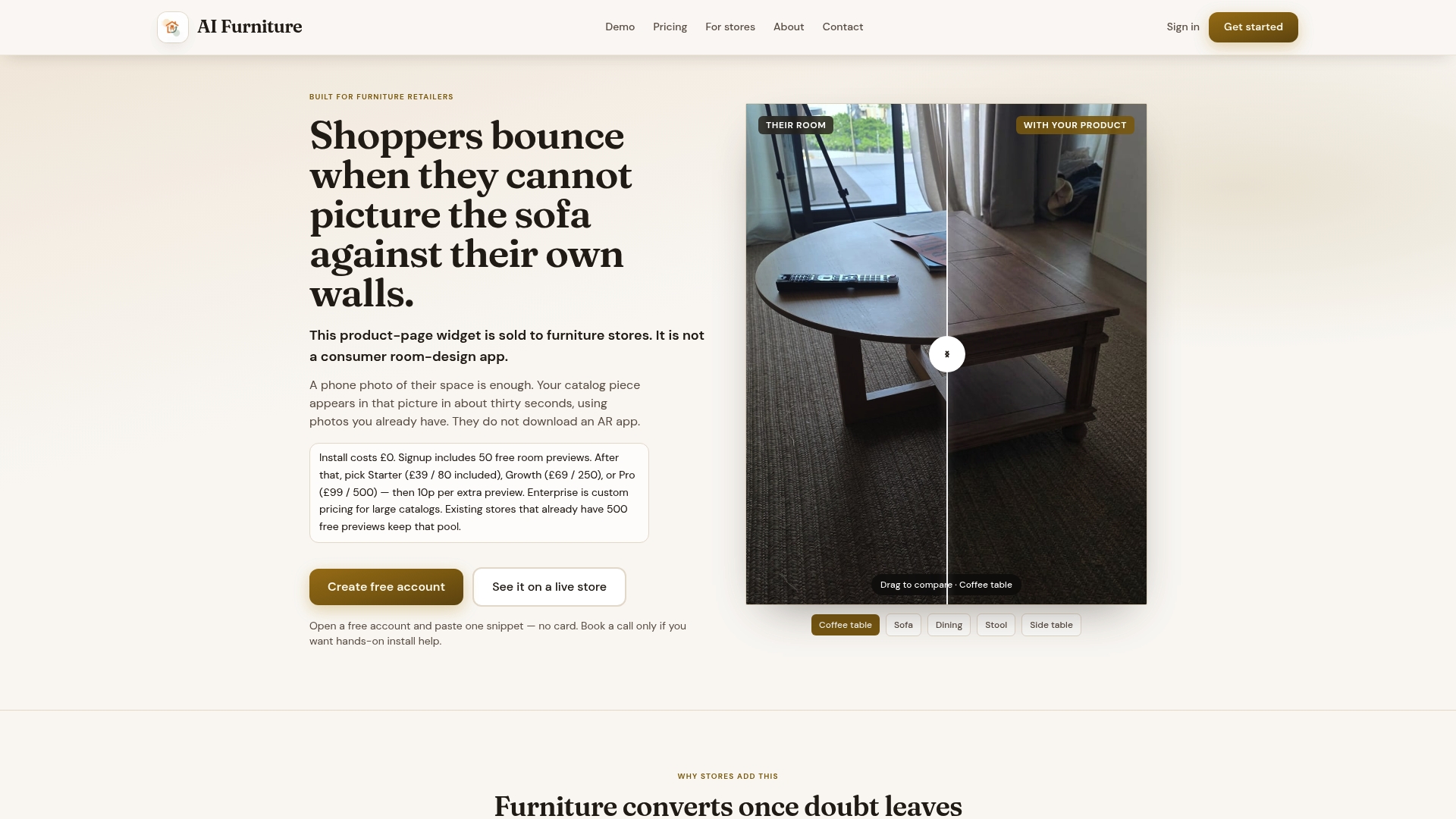
Retail visualisers are a genuinely useful test case because the value metric, a rendered room preview, is simple enough that any shopper or retail buyer understands it instantly, unlike API calls or compute hours. There's no app download, no 3D modelling overhead, and no long onboarding process before you see results. If you're evaluating usage-based pricing for your own product, running a merchant bake-off on your own catalogue photos shows you exactly how metering, allowances, and overage billing feel from the customer's side, using real product images rather than a demo environment. Request a bake-off and see how the numbers look against your current return rate before you decide anything.
Sources
- Usage-based billing explained: How it works and how to optimize its benefits
- Usage-Based Pricing Is Popular, But Is It Right For You? Our Rule of Thumb
- Usage-based billing implementation guide (Ordway Labs)
- Usage-Based Pricing vs Subscription Pricing (Zylo)
FAQ
What is usage-based billing?
Usage-based billing charges customers according to how much of a product or service they consume, such as API calls, storage, or previews generated, rather than a flat recurring fee.
How does usage-based billing work?
It runs through three stages: metering (recording usage events), rating (converting those events into billable amounts using your pricing rules), and invoicing (presenting the final charge clearly to the customer).
Can I bill customers based on usage?
Yes, provided you can meter the relevant activity accurately and reconcile it against invoices; most billing platforms and payment processors support metered pricing alongside or instead of flat subscriptions.
What does "usage-based" mean in pricing?
It means the price scales with consumption rather than staying fixed, so a customer who uses more pays more, and a customer who uses less pays less, within whatever caps or allowances the plan includes.
Is usage-based billing better than a subscription?
Neither is universally better. Usage pricing suits products where value scales cleanly with consumption, particularly software-to-software tools, while subscriptions or hybrids tend to suit products used directly by people who value cost predictability.