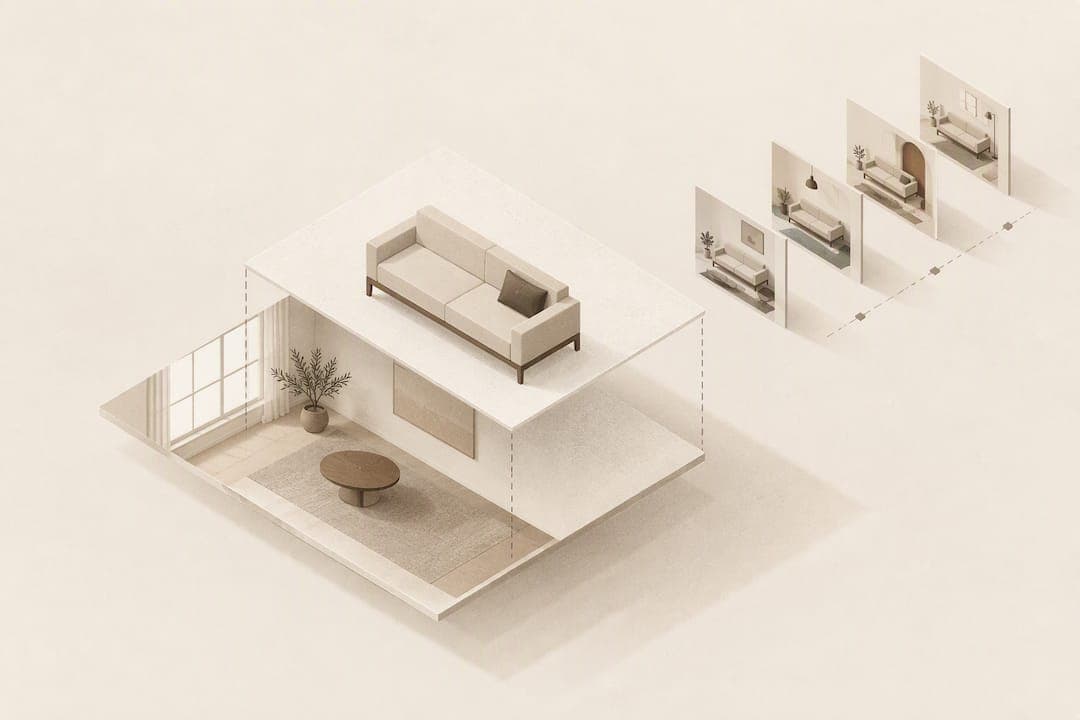
Lifestyle photography wins when authenticity, human context and social proof matter most, while 3D visualisation and photo compositing win when you need flexibility, many variants or fast early-stage marketing. Most furniture and homeware retailers get the best results from a hybrid mix, pairing a handful of genuine photoshoots with scalable rendered or composited lifestyle scenes.
TL;DR:
- 3D assets require an upfront modeling investment, then make added variants inexpensive; bespoke pieces with complex textures still demand more modeling work.
- Industry research points to a roughly even split between detail and lifestyle images, rather than relying on either image type alone.
- Pair disclosed or composited lifestyle imagery with at least one genuine studio photo; AI labels can affect perceived authenticity more for utilitarian products.
- Check marketplace rules before production, and favor photography or careful manual modeling for soft goods, reflective finishes, and fine details that scan poorly.
- Test image types on a small group of products, tracking conversion and return rates before rolling one approach across the catalog.
Table of Contents
- Lifestyle photos vs 3D visualisation: comparing the trade-offs
- What 3D visualisation and compositing do best
- What lifestyle photography does best
- Budget, timing and the practical limits of each approach
- Research-backed guidance for ecommerce image strategy
- Which route to choose next
- Balancing realism and scale in practice
- A practical way to add lifestyle context at scale
- FAQ
- Sources
Lifestyle photos vs 3D visualisation: comparing the trade-offs
Each method answers a different question for the shopper, and that shows up clearly once you compare them on the factors that actually affect a purchase decision.
- Realism and trust: genuine photography reads as authentic by default; 3D and compositing need good lighting and disclosure to match that trust.
- Flexibility: 3D visualisation and compositing adapt instantly to new colours, finishes or room settings, while a reshoot is needed for every new photography variant.
- Marginal cost per SKU: a photoshoot costs roughly the same for each new product; a 3D model or composited asset is expensive to build once, then cheap to reuse.
- Production time: photography depends on studio or location bookings; rendering and compositing can turn around in hours once the base asset exists.
- Catalogue scalability: visualisation and compositing scale across thousands of SKUs far more easily than repeated physical shoots.
- Channel fit: marketplaces and social platforms often expect or require at least one genuine photo, while product configurators depend on rendered variants.
Hedonic, aspirational products such as sofas and statement furniture tend to lean on lifestyle photography for emotional pull, while utilitarian, modular or highly configurable goods such as shelving or office furniture often suit visualisation and compositing better.
What 3D visualisation and compositing do best
Rendered and composited imagery earns its place in a catalogue mainly through coverage and consistency, not just novelty.
- Covers every colour, finish and size variant from a single base model without repeat studio time.
- Reuses a hero asset across a full collection, cutting the need for separate shoots per SKU.
- Scales efficiently across large catalogues, especially with parametric or rule-based automation for structured variants.
- Delivers consistent lighting, animated views and, in some setups, interactive or AR-style viewers.
The cost shape is the key difference from photography: an upfront investment in modelling or template building, followed by a low incremental cost for each new variant. Parametric pipelines can amortise modelling cost across colourways and finishes, though bespoke or highly textured pieces remain more resource-intensive to model accurately.
Pro Tip: Build one high-quality hero asset per product family first, then branch variants from it rather than modelling every SKU from scratch.
What lifestyle photography does best
Lifestyle photography does the emotional work that a rendered scene struggles to replicate. Seeing a sofa in a lived-in lounge, with a person's hand resting on the arm or a child curled up on a cushion, gives shoppers tactile and social cues that influence liking and purchase intent far more than a clean render does.
- Builds authenticity and social presence through human models and real environmental context.
- Helps shoppers judge scale, fit and texture more intuitively than a studio shot alone.
- Meets channel-specific norms on marketplaces and social platforms, where genuine photos are often expected or required by listing rules.
- Supports storytelling around how a piece is actually used, which rendered assets rarely convey as convincingly.
For statement or hedonic pieces where the purchase is driven by desire as much as function, lifestyle photography tends to carry more weight in the decision than technical accuracy ever could.
Budget, timing and the practical limits of each approach
Before briefing a photographer or a 3D studio, it helps to map out the real constraints rather than assume one method is universally cheaper or faster.
- Budget for photography per shoot day, including styling, location and models; budget for 3D or compositing as a one-off setup cost per hero asset, not per SKU.
- Expect photography lead times to include studio or location booking, shoot days and post-production retouching.
- Expect 3D modelling lead times to vary with texture complexity and reference photo quality, while compositing from existing photos can turn around far faster.
- Check material constraints early: soft goods, reflective finishes and fine details commonly produce lower-quality 3D scans and may need photography or careful manual modelling instead.
- Confirm platform rules before committing to an approach, since some marketplaces specify what the main product image must contain.
- Before hiring anyone, gather existing product photography, a list of SKUs and variants, target channels, and a rough per-SKU budget ceiling.
Our internal pricing comparison for furniture retailers walks through how these cost shapes play out across a typical catalogue.
Research-backed guidance for ecommerce image strategy
Recent academic work on AI-generated product imagery adds a useful wrinkle to the lifestyle-versus-visualisation question. Transparent labelling of AI-generated images can have a small positive effect on purchase intent, but the effect on perceived authenticity differs by category.

Transparent AI labelling shows a measurable direct positive effect on purchase intention, according to recent research on AI image disclosure, though the same labelling can reduce perceived authenticity more sharply for utilitarian products than for hedonic ones.
Separate industry research on image strategy points to a "holistic image proportion" of around 0.5, meaning roughly half detail or clinical shots and half lifestyle context, as the mix that tends to maximise perceived completeness and purchase intent.
- Pair AI-disclosed or composited lifestyle images with at least one genuine studio shot to anchor trust.
- Lean towards a near-even split of detail and lifestyle imagery rather than defaulting entirely to one type.
- Treat disclosure as a design choice, not an afterthought, especially for utilitarian product lines.
Photo compositing sits neatly inside this guidance: it produces lifestyle-style context from a retailer's existing product photos without building a 3D model or shipping an AR app, which makes the 50/50 mix achievable at catalogue scale.
Which route to choose next
Three simple rules cut through most of the decision-making here.
- Choose lifestyle photography when the product is hedonic, aspirational, or the channel expects genuine human-context imagery.
- Choose 3D visualisation when you need many configurable variants, a hero asset reused across a collection, or early-stage marketing before stock exists.
- Choose a hybrid or compositing approach when you need lifestyle-style context across a large catalogue without the time or cost of full photoshoots or 3D builds.
A short procurement brief should specify: the SKUs and variants in scope, required output formats, one genuine reference photo per hero product, target channels and their image rules, and a question to any vendor about how pricing scales as the catalogue grows.
Balancing realism and scale in practice
Having watched retailers lean too hard on either pure photography or pure rendering, the pragmatic path is almost always a mix, tested in small batches before a full rollout. Track return rates and conversion on a handful of SKUs with each image type before committing a whole catalogue to one method. Our furniture visualisation pricing notes and comparison resources are worth a look once you are ready to scope a test.
— Michael
A practical way to add lifestyle context at scale
For retailers who need realistic lifestyle previews without committing to a full 3D pipeline, we developed a product-page widget that composites a shopper's own room photo with furniture quickly, requiring no app download or 3D model.
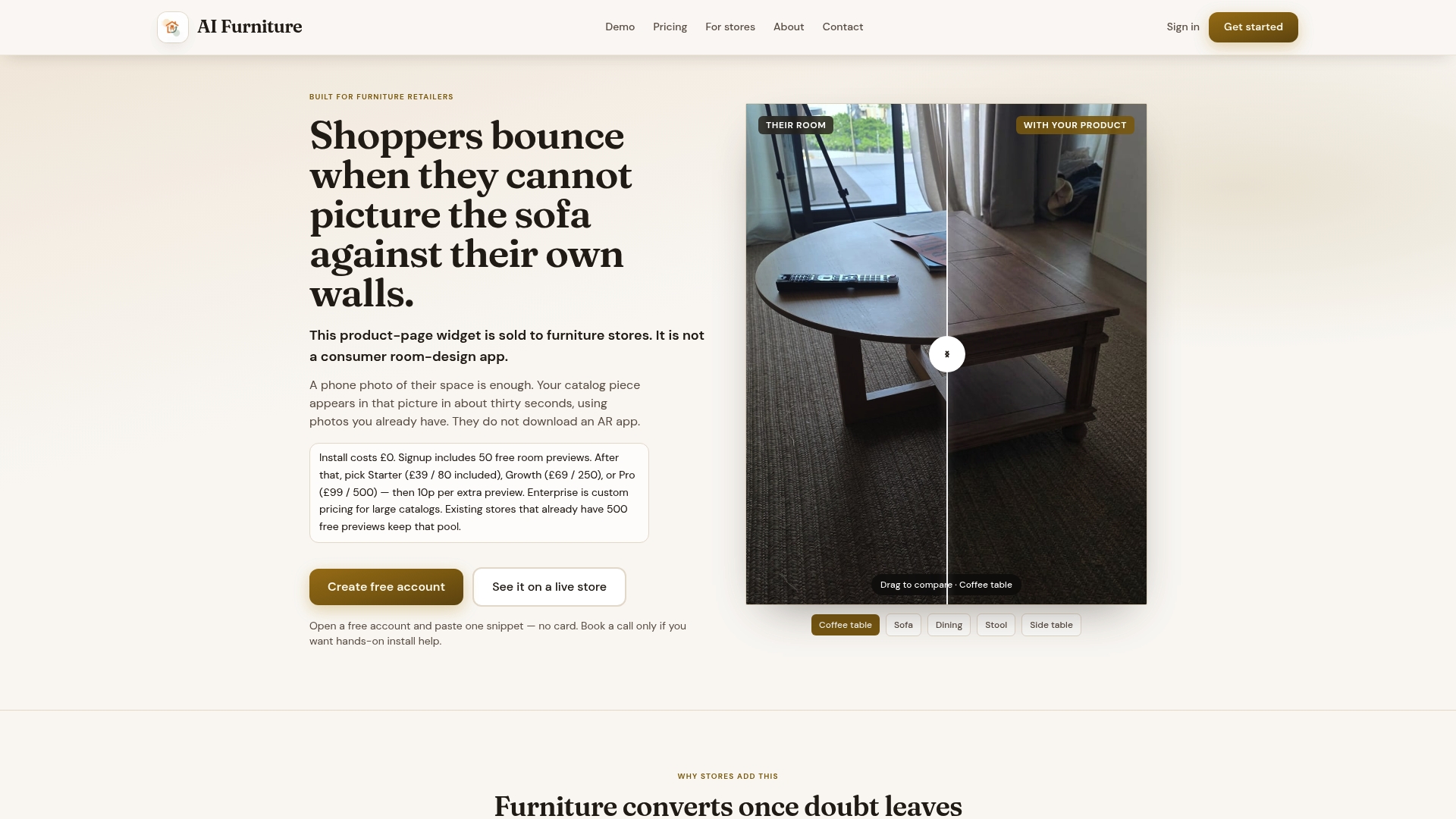
- Works from the product photos you already have, rather than requiring new 3D assets per SKU.
- Integrates with major e-commerce platforms and custom storefronts.
- Suits various catalogues, seasonal launches, or retailers wanting quick lifestyle previews to help reduce fit-related returns.
You can start with free previews to test the widget against your own catalogue before paying for additional usage. See how it works on our furniture visualiser page, or check plans and per-preview pricing on our pricing page.
FAQ
What is a lifestyle image?
A lifestyle image shows a product in a realistic setting, often with a human model or everyday context, rather than isolated against a plain background. It aims to communicate how the product feels to own and use, which is why industry comparisons of studio and lifestyle photography treat the two as serving different jobs on the same listing.
How did photography impact visual storytelling online?
Photography gave retailers a direct way to show products in real contexts rather than relying on illustrations or descriptions alone, which shaped how shoppers judge fit, scale and desirability before buying. That expectation now extends to ecommerce, where a mix of studio and lifestyle imagery is used to cover both clarity and aspiration.
Do products look different in photos compared with how they appear in person?
Lighting, angle and retouching can all shift how a product appears in a photo compared with its real-world look, which is one reason platforms increasingly ask for disclosure when imagery is AI-generated or heavily composited. Pairing a genuine studio shot with any rendered or composited lifestyle image helps keep the gap between the two as small as possible.
When should I use 3D visualisation instead of photography?
3D visualisation suits situations with many colour or finish variants, large catalogues, or early-stage marketing before physical stock exists, since one base model can generate multiple outputs cheaply. Photography tends to win when the product is hedonic or aspirational and the channel expects genuine human-context imagery.
Can photo compositing replace both lifestyle photography and 3D modelling?
Photo compositing can produce realistic lifestyle context from existing product photos without building a 3D model, which suits retailers who want scale without the setup cost of full 3D. It works best alongside at least one genuine studio shot, in line with the balanced image-mix approach industry research on image strategy recommends.
Sources
- Beyond the label itself: how disclosed content shapes consumer responses to AI-generated product imagery in E-commerce
- Industry findings on image strategy and holistic image proportion
- Lifestyle vs studio product photos: when each wins